Snorkeling Molokini Crater: The Cove, the Back Wall, the Rules and the Best Time
Molokini is one of the few places where you snorkel inside a volcano. The islet off South Maui is the rim of an extinct crater, and the sheltered water inside the crescent is the crater’s flooded floor. Hawaii’s Division of Aquatic Resources (DAR) calls it one of Hawaii’s most famous snorkeling and diving destinations, accessible only by boat, and rates the diversity of fish and other marine life there among the most impressive in the state.
It is also one of the most protected. The water is the Molokini Shoal Marine Life Conservation District, roughly 77 acres established in 1977, and the islet above it is a state seabird sanctuary that nobody may land on. This guide covers what you will find in the water, the rules that come with it, when conditions are best and how to look after yourself and the reef. For choosing a boat, see our snorkel tours guide.
A volcano rim three miles offshore
Molokini is a crescent-shaped islet in the ‘Alalākeiki Channel, about 3 miles off Maui’s southwestern coast. The state’s wildlife division describes it as a horseshoe-shaped tuff cone of Haleakalā, the volcano that forms East Maui, lying about midway between Maui and Kaho’olawe. Above water it is small: approximately 22 acres, reaching a height of 160 ft. The outer slope is steep and bare; the inner slope is gentler and carries most of the plants.
What makes it a snorkel site is the shape: the crescent wraps around a cove that is sheltered from much of the open channel. DAR’s description is simple: the islet is the southern rim of an extinct volcanic crater, and the shallow inner cove is the crater’s submerged floor.
The conservation district is divided into two subzones:
- Subzone A is the cove itself, bounded by a line from the end of the submerged ridge off Lalilali Point to Pahe’e O Lono Point.
- Subzone B extends 100 yards seaward of the islet and Subzone A, wrapping round the outside.
Inside the cove: where you snorkel
Most snorkeling at Molokini happens inside the crescent. DAR’s description of the cove is the best map you will get:
- There is no sand beach on Molokini; the shoreline drops straight into the water.
- The cove slopes from the shoreline to about 100 feet deep before dropping off further.
- The bottom is a mix of sand patches, coral and basalt boulders.
- A shallow reef in less than 30 feet of water runs north from the shoreline at the islet’s northwestern point.
The water is the attraction. DAR says the cove shelters one of Hawaii’s most diverse marine ecosystems, with exceptionally clear water and abundant reef fish. The operators go further and disagree with each other on the number: one says visibility inside the crater is often more than 100 feet, another puts it at up to 150 feet, and a third advertises up to 200 ft. All three agree that on a good morning you can see the bottom from the surface even where it is deep.
The back wall
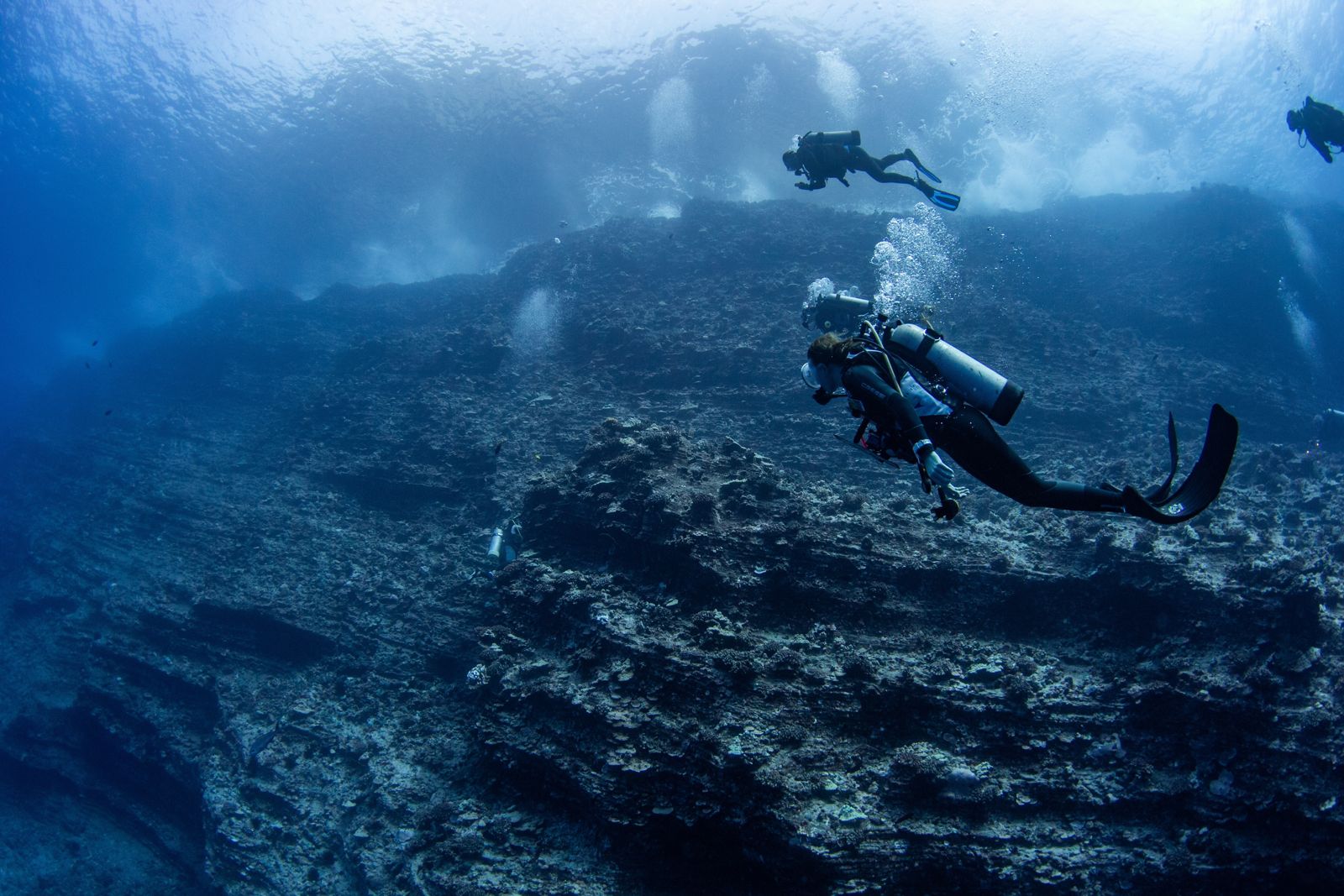
The outside of the crescent is another world. DAR describes the back (southern) side of the islet as a steep face dropping to depths of over 200 feet, with small patches of coral scattered across it and crevices and outcroppings that harbor large populations of fish. It is popular with experienced divers for its steep topography.
The back wall is also where Molokini’s black coral survives. Black coral was once abundant in the deeper water around the islet and was heavily harvested; harvesting is now restricted, and small colonies can still be found on the back wall.
Most snorkel trips never go there, because the open water outside the cove is more exposed. DAR warns that currents can always be a problem outside the cove, and tells divers on the back wall to keep an eye on their depth gauge. One sailing operator sometimes makes its second stop at the back side of Molokini instead of Turtle Town, when the weather allows; if that is your boat, follow the crew’s briefing closely.
What you are likely to see
Operators put the count of fish species at Molokini at over 250 (one says approximately 250 marine species), and they are the ones in the water every day. Names you will hear in the crew’s briefing:
- Reef fish: parrotfish, black triggerfish and longnose butterflyfish are among those one crew lists inside the crater.
- Bigger visitors: another names ulua (giant trevally), manta rays and monk seals among the crater’s wildlife.
- Whales: DAR notes that humpback whales have been known to enter the cove itself.
- Reef sharks and eels: a Kihei raft company adds moray eels and whitetip reef sharks to the list.
- Turtles: one raft company says plainly that you are not likely to see turtles at Molokini itself. They are more reliable at the usual second stop, Turtle Town off the south side of Maui, which one operator describes as home to many large sea turtles and reef fish.
Above the water, the islet is the attraction for seabirds, which is the reason it is closed. It is also home to the ‘ihi, Portulaca molokiniensis, an endemic plant listed as endangered.
None of this is guaranteed. Operators are careful to say that wildlife sightings, while likely, are not guaranteed.
The rules of the conservation district
Because Molokini is a Marine Life Conservation District, its rules are stricter than an ordinary beach. They are set out in Hawaii Administrative Rules chapter 13-31. In the water you may not:
- Take or injure marine life. Fishing for, taking or injuring any marine life, eggs included, is prohibited; the only exception is trolling for finfish in Subzone B.
- Feed the fish. Feeding fish or putting any food or attractant in the water is prohibited.
- Touch or take coral, sand or rock. Taking or altering sand, coral or any other geological feature is prohibited, and so is having in the water any device that could be used to do it.
- Carry gear for taking marine life. Possessing in the water any device that may be used to take marine life is itself prohibited.
The boats have their own rules. Anchoring is prohibited when a day-use mooring system is established by the department, and boats may moor for commercial activities only as a permit allows. Commercial activity that puts people in or on the water, including swimming, snorkeling, diving, kayaking or paddling, needs a permit. That is why you go with a permitted operator rather than any boat that offers.
DAR asks people to report violations to 643-DLNR (3567).
Why nobody lands on Molokini
DAR is blunt: Molokini is a state seabird sanctuary, and entry onto the islet is prohibited. The state’s wildlife division adds that, as with all state seabird islet sanctuaries, visiting Molokini is prohibited, and that the sanctuary is closed under chapter 126 of the administrative rules.
The reasoning is on the same page. These islets are rare places where seabirds can nest with few or no predators and no large mammals, humans included, trampling the burrows where they raise their young. So the islet is for looking at from the water. No activities are possible on it without a permit, and commercial activities are prohibited outright.
Currents, wind and the morning
The single most useful sentence about Molokini conditions comes from DAR: currents can always be a problem outside the cove, and may get stronger inside in the afternoon when the wind picks up.
Practical consequences:
- Go in the morning. Almost every snorkel trip does. The earliest sunrise departure from Makena checks in at 5:45 a.m. and aims to be the first boat into the crater.
- Expect changes. Captains choose the snorkel sites on the day by weather, swell height and direction. If the crater is rough, the boat goes elsewhere.
- Stay inside the line. Follow the crew’s limits on where to swim. The cove is sheltered; the water outside the rim is not.
- Use the flotation. Boats provide flotation devices, and at least one operator requires them for safety. There is no shame in a noodle or a vest in water this deep.
How a snorkel stop works
A Molokini stop follows the same pattern on almost every boat, and knowing it helps you make the most of the time in the water.
- The briefing. On the way out the crew explains the gear, the boundaries of the swim area and the conservation rules. Listen for where the boat wants you to stay; that line is about the current, not about keeping you close.
- The gear. Masks, snorkels, fins and flotation devices are supplied. One sailing operator stresses that its snorkel equipment is sanitized and that flotation devices are required for safety. Bring your own mask if you have one that fits well.
- Getting in. One big catamaran lowers wide staircases through the water’s surface and also has two water slides; another has a waterslide off the deck. Rafts sit much lower, so getting in is a short slip over the side.
- In the water. Float face down, keep your fins off the bottom and move slowly. Look down the slope as well as along the shallow reef.
- The photographer. On at least one Ma’alaea trip an underwater photographer swims with the group. Some South Maui trips include photos in the price.
- Time to leave. When the crew calls everyone back, head straight for the boat; the schedule usually includes a second stop.
Molokini or Turtle Town?
The two names appear together so often that it is worth knowing how they differ. Molokini is the deep, clear crater offshore, with the more dramatic setting; it is also more exposed, and the captain will skip it if the channel is rough. Turtle Town is along the South Maui coast, closer to shore, where the draw is the green sea turtles rather than the variety of reef fish. A typical half-day trip does the crater first, while the morning is calm, and Turtle Town second.
If the crater is closed by weather on your day, a Turtle Town or coastal stop is not a consolation prize: it is often where the turtles are. And if you are on a short raft trip that only visits the crater, ask whether a turtle stop is possible before you book.
Sunscreen: mineral only
Maui County is stricter than the rest of Hawaii on sunscreen. Ordinance No. 5306 bans the sale, distribution and use of non-mineral sunscreens without a prescription, and since October 1, 2022, only mineral sunscreens have been allowed in the county.
What to pack:
- Mineral sunscreen. The county asks visitors to choose mineral sunscreens made with non-nanotized zinc oxide or titanium dioxide.
- Cover instead of cream. The county’s first line of defense is to avoid the peak sun between 10:00 am and 2:00 pm, seek shade and wear protective clothing, including rash guards and wetsuits in the water.
- A rash guard or wetsuit top. One sailing operator lends wetsuit tops on request; another rents wetsuits at $10.00.
Maui County’s reasoning is that chemicals in some sunscreens wash off bodies and harm coral and other marine life.
Turtles, seals, dolphins and whales: keep your distance
Sea turtles, monk seals, dolphins and whales are wild animals protected under state and federal law. NOAA Fisheries sets out how close you may get:
- Sea turtles: at least 10 feet (3 meters) away, on land and in water.
- Hawaiian monk seals: at least 50 feet (15 meters) away. Monk seals are becoming increasingly common in the main islands.
- Spinner dolphins: federal law prohibits swimming with, approaching or remaining within 50 yards of them in Hawaii.
- Humpback whales: federal law prohibits approaching within 100 yards, by boat, kayak, drone or swimming.
NOAA’s general rule is to never touch, chase or feed, and to limit viewing to a few minutes. If you see a sick, injured or stranded animal, NOAA’s statewide Marine Wildlife Hotline in Hawaii is (888) 256-9840.
Of the five sea turtles known in Hawaiian waters, only the endangered hawksbill and the threatened green sea turtle are commonly found, and the green turtle is the one you will meet.
If you are not a strong swimmer
Molokini is deep, but it is not only for strong swimmers.
- Flotation devices come with every trip.
- Instruction. Basic swimming skills are recommended, and crews teach beginners how to use the gear. One Ma’alaea crew says even first-timers and weak swimmers can snorkel with its help.
- Stay dry and still see it. Some catamarans have a glass-bottom section, so anyone who stays aboard can watch the fish.
- Go a little deeper. SNUBA, breathing through a hose from a tank at the surface, is offered as an upgrade on some boats for ages 8 and older, down to 20 feet.
Seasickness and comfort
The crater is out in an open channel, so the ride matters.
- The ride from Ma’alaea to the snorkel location is approximately 60 minutes by one operator’s estimate; from Makena it is 3 miles.
- Seasickness tablets are sold on at least one boat (Dramamine, 2 tablets for $5.00), but they work best taken before you leave.
- Alcohol waits. Boats serve it only after the snorkeling is over.
- Warmth. Bring a light jacket or cover-up for the ride home.
Whale season at the crater
From November through April, visitors to the Hawaiian Islands Humpback Whale National Marine Sanctuary can see whales from shore and at sea, and the peak is January through March. Each winter and spring roughly half of the North Pacific humpback whales come to Hawaiian waters to breed, calve and nurse. On a winter trip, watch the horizon on the ride out.
If you want to learn more before you go, the sanctuary’s lecture hall at 726 S. Kihei Rd., Kihei, hosts free monthly talks open to the public.
A short checklist
- Book a morning trip, and accept that the captain may change the site.
- Pack mineral sunscreen, a rash guard and a cover-up.
- Do not touch, feed or take anything in the water.
- Keep 10 feet from turtles and 50 feet from monk seals.
- Use the flotation and stay where the crew tells you.
- Do not expect to land: the islet is closed.
For the boats and their prices, read our snorkel tours guide; for harbors and parking, how to get to Molokini.
Frequently asked questions
How deep is the water at Molokini?
The cove slopes from the shoreline to about 100 feet deep before dropping off, with a shallow reef in less than 30 feet of water at the northwestern point. The back wall drops to over 200 feet.
Is snorkeling Molokini good for beginners?
Yes, inside the cove and with the boat’s flotation devices. Basic swimming skills are recommended, and crews teach beginners.
Can you touch the coral or feed the fish?
No. Taking or altering coral and feeding fish are both prohibited in the conservation district.
Can you climb onto Molokini?
No. It is a state seabird sanctuary and entry onto the islet is prohibited.
When is the water calmest?
In the morning. DAR warns that currents can get stronger inside the cove in the afternoon when the wind picks up.
What sunscreen can I use?
Mineral sunscreen only. Since October 1, 2022, only mineral sunscreens are allowed in Maui County.